Let’s look at The Anastasia Ballet Behind the Scenes and how it all came together.
Anastasia was choreographed by Kenneth MacMillan and he used music by Tchaikovsky (Symphonies no. 1 and no. 3. He also used Fantasies Symphonies by Bohuslav Martinu.
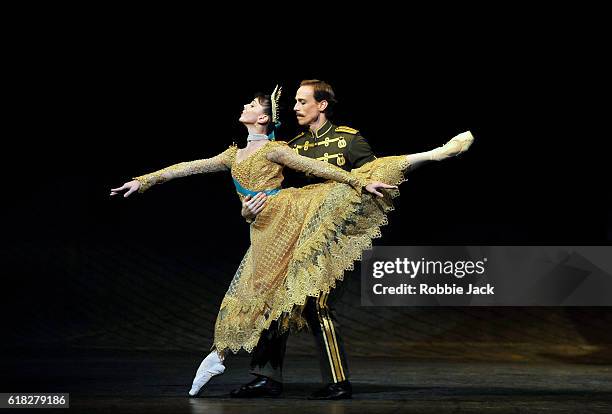
The scenery and costumes were were done by Barry Kay and Anastasia was first performed by the Royal Ballet at Covent Garden on the 22nd of July 1971.
Lynn Seymour was the Grand Duchess Anastasia/Anna Anderson in the original production.
Derek Rancher danced the Tsar Nicholas II. Svetlana Beriosova danced Sarina Alexandra Feodorovna. Adrian Grater was Rasputin and Antionette Sibly was M F Kshessinskaya with Anthony Dowell as her partner. David Adams was Anna’s husband.
Synopsis of The Anastasia Ballet
Act 1:
August 1914 in the countryside, the Imperial Family are at a picnic on the Baltic coast with their guest, who include the Tsarina’s great friend, Mme Vyrubova, and a group of naval officers from the Imperial yacht. The party is broken up as the Tsar receives news of the outbreak of war.
Act 2:
Petrograd 1917. Despite rapidly growing social unrest the Tsar is giving a ball in the Winter Palace to celebrate the coming-out of his younger daughter, Anastasia. He has invited the ballerina M F Kshessinskaya with whom he had a liaison before his marriage, to dance with the guests.
Anastasia is puzzled by the relationships which she observes between various members of the court. The ball is then nvaded by revolutionaries.
Act 3:
Some years later.
For the woman who believes she is Anastasia, past and present intermingle. She relives incidents from the years since the massacre of the Imperial family at Ekaterinburg by the Bolsheviks; her rescue by two brothers; the birth of her child; her marriage; the death of her husband; the disappearance of her child; her attempted suicide and the confrontations over the years with the surviving members of the Imperial family who deny her identity as the Grand Duchess Anastasia.
Anastasia Ballet Behind The Scenes
Anastasia, as a three-act ballet, developed from a one-act work which MacMillan staged in Berlin in 1967 while director of the Deutsche Opera Ballet.
Set to Bohuslav Martinu’s Fantaisies Symphoniqus, with a specially composed electronic passage to introduce the bemused figure of Anna Anderson in her Berlin hospital bed, the work starred Lynne Seymour as an unforgettable portrayal of a woman desperately trying to recall her own identity and then persuade an inimical world of the fact that she was a survivor from the Bolshevik massacre of the Russian Imperial family in 1918.
On his return to London to direct the Royal ballet, and with Lynn Seymour also returned to the company, MacMillan decided to extend the ballet ‘backwards’, to provide the portrait of the woman in the Berlin hospital as she believed herself to be.
The result was a grand company ballet, deploying the full forces of the Royal Ballet as a troupe of dancers and dance actors, and a major work of art, innovative in suggesting how history might be converted into poetic truth, no less truthful in its deepest sense for being in some way a fantasy upon historical fact.
Anastasia works on two levels. Its surface is an evocation, in the first two acts, of the world as seen through the eyes of the young Grand Duchess Anastasia ( her view of the world is the ballet’s view – an important factor in considering the relationships which are shown to us throughout).
The opening scene is idyllic, the Tsar and his wife and children picnicing on the Baltic Coast, the formalities of court life relaxed, and the Imperial family free to be a family first, and Imperial second.
But even here the second level of the ballet is important. MacMillan is not concerned with a literal representation, though the child Anastasia enters on roller-skates; her games with her sisters and the young officers delightfully truthful. Rather he is concerned with the inner landscape of the emotions which has always attracted his narrative gifts.
The first act is almost plotless on naturalistic terms, until the last pages of Tchikovsky’s first symphony (Winter Daydreams) the musical text for Act 1, when the news of the outbreak of war is brought to the Tsar.
Instead we are offered a study in human relationships, the extraordinary emotional world of the Imperial family.
There are ebullient sequences for a group of naval officers; sweeping dancers for Anastasia and her three sisters; a lilting folk dance-like number for the Sarina, her friend Anna Vyrubova and her daughters.
With the added weight of MacMillan’s poetic drama, they seem irrestiibly touching, and accentuate the dramatic highlights of the act: the Tsarevich’s fall, and the fear that his hemophilia will strike; the duet in which the Tsar’s reliance upon his wife is so clearly shown, and the arrival of the telegram that announces the outbreak of war.
In the second act MacMillan’s concern with the surface of events and their inner relevance to the drama and to the emotional world of Anastasis is also strong. Anastasia, on the brink of womanhood, is caught up in the splendor of a court ball- magnificent dances for the corps de ballet here, but also aware of undercurrents of feeling and hidden drams between her parents, and between her father and his erstwhile mistress, and wounded soldiers we know the Revolution is brewing, inside the warm, burst in. In both these acts MacMillan’s use of his symphonic scores is most sensitive. Inevetibly they dictate the placing of dramatic effect, but MacMillan has not been a slave of his music (save in having to fight against credentials).
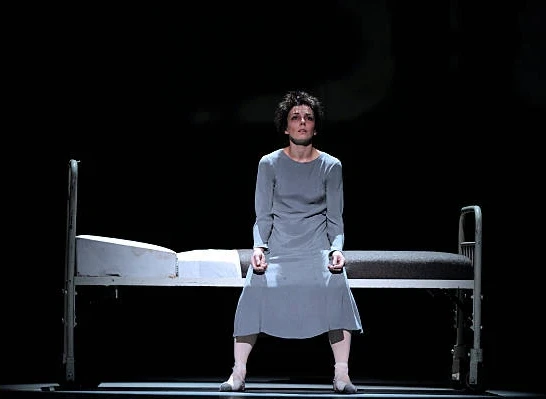
With the third act, and Anna Anderson’s quest for identity, we understand fully the relevance of the events and incidents we have seen earlier in the ballet. Personalities, suffering, time itself, form part of a psychic labyrinth through which Anna Anderson wanders in search of herself and recongnition by the world.
The drama, as Andrew Porter observed in the Financial Times, is about ‘much more than the plight of one wronged, or a possibly deranged, woman. It is about a changed world; a ballet about security and violence, happiness precariously embraced, and loneliness.’ at the end,
Anna Anderson seems to grasp all her courage of spirit, and sitting on her hospital bed she circles the stage, sure of herself now, and defiant of the world’s incredulity. we have seen a considerable work of art.
As Anastasi/Anna, Lynn Seymour gives one of the greatest dance performances of our time. The role is vastly challenging, from beguiling fourteen-year-old child to crop-haired and distraught woman.
At eery moment Seymour’s dancing bespeaks truth, beauty, total identification with the character, entire sympathy with the being she is playing – or rather, has become for us. Among the other Royal Ballet performances, Derek Rencher’s impersonation of the Tsar, weak, charming, vacillating at every crissis, and Svetlana Beriosova’s assumption of the Tsarina’s part, were of great sensitivity and dramatic skill.
The decor by Barry Kay, a permanent set of spiraling parchment-like shapes which become in turn a baltic forest, a palace and a landscape of the mind, are amount the best design British Ballet has had.
His costuming is of similar quality. Yes Anastasia’s importance transcends all these contributory factors. MacMillan has, in this beautiful work of art, extended the capabilities of the three-act ballet.
For the first time in the West, there was a work which escaped from the restrictions of its form, finding in recent history a theme that permitted lengthy treatment, and one which transmuted history’s truth into a no less truthful poetry.



The description of Lynn Seymour portraying both the lively fourteen-year-old Anastasia and the deeply distressed Anna Anderson made me wonder how a dancer prepares for such an extreme transformation within one ballet. It must require much more than changing the costume or hairstyle, because the audience needs to feel that the character’s entire inner world has changed. Did Seymour use noticeably different posture, movement quality, or facial expression in the third act to separate Anna from the young Anastasia? I would be especially interested to know whether MacMillan gave her very specific acting directions or allowed her to develop much of that emotional contrast herself.
Some interesting thoughts there Hanna. I would love to know myself, but most of MacMillan’s ballets involve a lot of acting, so I am sure he must train his dancers for this.
Hey, Michel. Your article about dance is interesting. I found the discussion of Anna Anderson’s search for identity particularly interesting, especially how MacMillan used the ballet to move beyond a straightforward historical retelling.
How challenging is it for a dancer to portray such a psychologically complex character across three different stages of her life, from the young Anastasia to the troubled Anna Anderson?
Hi John,
I have never had a role like this, but I think it must be extremely challenging, and like acting, the dancer must become the character to actually portray the part convincingly. It think it must very taxing on the dancer who has to both dance and act.
Beautiful!!
What aspects of MacMillan’s choreography do you think make Anna Anderson’s shifting memories and uncertain identity so powerful onstage? The contrast between the imperial family’s early world and the intensity of the hospital scenes seems designed to make the final act feel even more personal and unsettling.
Also, do you feel the use of Tchaikovsky alongside Martinů helps separate Anastasia’s remembered life from Anna’s fractured present, or does it blur the line deliberately? I’d also be curious which design element from Barry Kay’s production most effectively supported that journey through memory, history, and emotional turmoil. Thanks!
That’s a tricky one to answer Aly. For one we know that Anna Anderson was not really the princess, but this was only proven after the ballet was choreographed. So I think the MacMillan portrayed a woman that really believed that she was the dead princess, which is what makes the ballet and acting so powerful.
I thought that the music beautifully complimented the story and added to the drama, but that is my opinion.