
Marie Taglioni famous ballet dancer is famed in the ballet world as she was the one who made dancing on pointe possible for many future generations of ballerinas.
She was a Swedish-born ballet dancer and was well known in the Romantic Ballet Era.
She was born on the 23rd of April 1804 on Stockholm to Italian choreographer Filippo Taglioni and Swedish ballet dancer Sophie Karsten. Her brother Paul was also a dancer and an influential choreographer and they performed together early in their careers.
She spent most of her life in the Austrian Empire and France and was one of the most celebrated ballerinas of her time. She is credited with, although not confirmed, as being the first ballerina to truly dance on pointe.
Dance Training
Taglioni moved to Vienna with her family at a very young age where she began her ballet training under the direction of Jean-Francois Coulon and her father.
After Filippo was appointed the ballet master at the court opera in Vienna there was a decision that Marie would debut in the Habsburg capital.
Even though Marie had trained with Coulon, her technique was not up to the standards that would impress the Viennese audiences. Her father then created a rigorous six-month training regimen for his daughter where she would hold positions for 100 counts. The training was conducted daily and consisted of two hours in the morning with difficult exercises focusing on her legs and two hours in the afternoon focusing on adagio movements that would help her refine poses in ballet.
Taglioni had a rounded back that caused her to lean forward and had “slightly distorted proportions”.
However, she worked hard to disguise her physical limitations by increasing range of motion and developing her strength.
Taglioni focused her energy on her shape and form to the audience and less on bravura tricks and pirouettes. In Vienna, Marie danced her first ballet choreographed by her father titled “La Reception d’une Jeune Nymphe à la Cour de Terpsichore”.
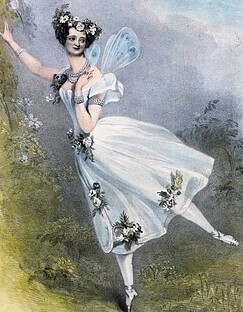
Lithograph by Chalon and Lane of Marie Taglioni as Flora
Before joining the Paris Opéra, Taglioni danced in both Munich and Stuttgart, and at age 23 debuted in another ballet choreographed by her father called “La Sicilien” that jump-started her ballet career.
Taglioni rose to fame as a danseuse at the Paris Opéra when her father created the ballet La Sylphide (1832) for her. Designed as a showcase for Taglioni’s talent, it was the first ballet where dancing en pointe had an aesthetic rationale and was not merely an acrobatic stunt, often involving ungraceful arm movements and exertions, as had been the approach of dancers in the late 1820s.
The diaphanous dress she wore in La Sylphide, with its fitted bodice and airy, bell-like skirt, was the prototype of the tutu, the full, light skirt that, in various lengths, has remained the accepted uniform of the classical dancer for more than a century. Not only did she have Paris at her feet but audiences in London, Milan, Vienna, Berlin, and St. Petersburg hailed her as one of the greatest dancers ballet had ever produced.
Pas de Quatre

Taglioni (center) in Pas de Quatre, 1845
In 1837 Taglioni left the Ballet of Her Majesty’s Theatre to take up a three-year contract in Saint Petersburg with the Imperial Ballet (known today as the Kirov/Mariinsky Ballet).
It was in Russia after her last performance in the country (1842) and at the height of the “cult of the ballerina”, that a pair of her pointe shoes were sold for two hundred rubles, reportedly to be cooked, served with a sauce and eaten by a group of balletomanes.
Married Life For Marie Taglioni
Marie Taglioni was married to Auguste Gilbert de Voisins in 1835, but they separated in 1836.
Later she fell in love with Eugene Desmares, a loyal fan, who had defended her honour in a duel.
Desmares and Taglioni gave birth to an (illegitimate) child in 1836. Tragically, Desmares died in a hunting accident three years later.
She gave birth to her second child, but is unknown who the father is even though the birth certificate states the father as Gilbert de Voisins.
Taglioni’s children’s names were Count Georges Philippe, Marie Gilbert de Voisins and Eugenie-Marie (Edwige) Gilbert de Voisins.
Retirement, last years and death
.jpg)
Taglioni – 1845
Taglioni retired from performing in 1847.
When the ballet of the Paris Opéra was reorganized on stricter, more professional lines, she was its guiding spirit.
With the director of the new Conservatoire de danse, Lucien Petipa, and Petipa’s former pupil, the choreographer Louis Mérante, she figured on the six-member select jury of the first annual competition for the corps de ballet, held on 13 April 1860.
Her only choreographic work was Le papillon (1860) for her student Emma Livry, who is remembered for dying in 1863 when her costume was set alight by a gas lamp used for stage lighting.
Later in England, she taught social dance and ballroom to children and society ladies in London; she also took a limited number of ballet pupils.
Taglioni died poor in Marseille on 22 April 1884, the day before her 80th birthday.
The local dancers began leaving their worn pointe shoes on the Montmartre grave as a tribute and thanks to the first pointe dancer.