
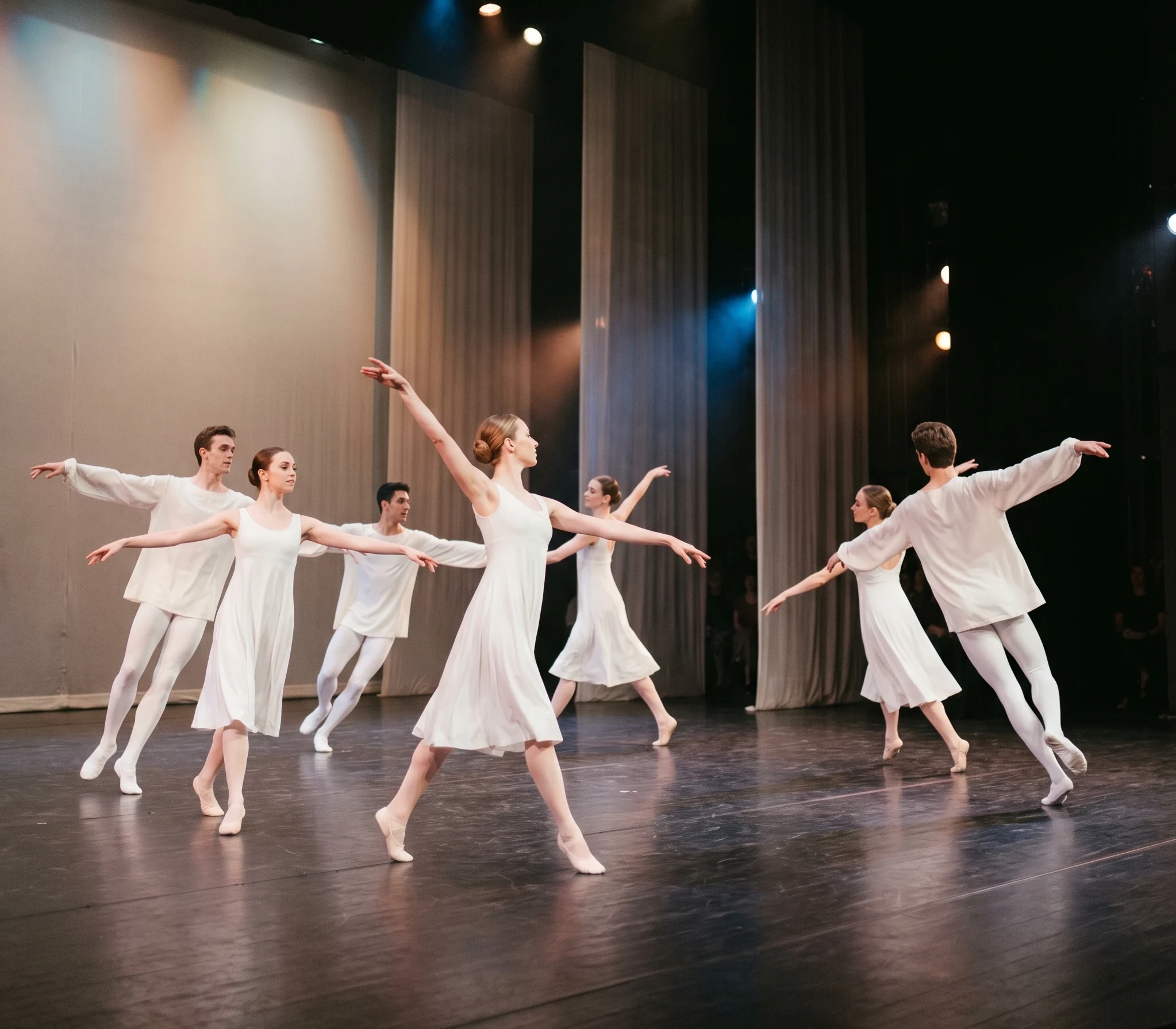
The Song Of The Earth Ballet is a one act ballet created by Kenneth MacMillan.
The music was by Mahler (Das Lied von der Erde). This was Mahler’s Ninth Symphony, but superstitiously he refused to give it the title. This symphony for tenor and alto voices and orchestra was composed in 1907-8, using recently published translations of Chinese poems as text and to the final poem, The farewell, Mahler added the following lines:
“The dear Earth blossoms in the Spring and buds anew
Everywhere and forever the luminous blue of distant space!
Forever…forever…forever…forever…”
These are the clue to the work, which is Mahler’s farewell to the joy and beauty of the world, which are all transitory, but which are always renewed.
The first performance of The Song Of The Earth was on the 6th of November 1965 and it was performed by Stuttgart Ballet.
The first performance by The Royal Ballet was at Covent Garden on the 19th of May 1966. Both these were danced by Marcia Haydee as the woman.
Here is the Royal Ballet in rehearsal for The Song Of The Earth Ballet more recently.
The ballet is ultimately about death, not as a menacing and dreadful figure, but as the inevetable companion and participant in all human activity. The ballet’s subject is that of a man and a woman. Death takes the Man and then they both return to the Woman, and in the last song, The Farewell, there is a promise of renewal.
The first song, ‘The Drinking Song of Earthly Sorrow’, shows the Man running on with five other boys, leaping and soaring, celebrating the brief joys of the world. At the end of the Messenger of Dearth claims the Man.
The slow movement, ‘The Lonely One in Autumn’, is written for the Woman with three other girls. At first they are partnered by four men, but these leave and there follows a pas de deus for the Woman and the Death figure, which ends with the woman solitary and sorrowing. – ‘Oh sun of Love, never again wilt thou shine, gently to dry my bitter tears?’
Then come three Scherzi, the first ‘Of Youth’, shows a group of young people enjoying themselves in games and chatter around a green and white porcelain pavilion, (there are not sets in the ballet and costumes are simple leotards and tunics, with the Messenger of Death wearing a half-mask. MacMillan’s imagery throughout the work is vivid and we seem to see the settings and locations.
When the poem speaks of everything mirrored in the smooth surface of the quiet pond that surrounds the pavilion, MacMillan shows his soloist momentarily inverted. It is a fresh, youthful scene filled with innocent joy and at the end the Messenger enters to carry of the principal girl soloist.
The second scherzo, ‘Of Beauty’, shows a group of girls picking lotus flowers by the river’s edge, and on dash young men on horseback. The loveliest of the maidens send the rider glances of yearning, and MacMillan shows us just this passion and happiness are perfectly expressed.
The following ‘Drunkard in Spring’ finds the Man carousing with two cronies, but there is a fourth member to their party, the Death figure, and at the end as spring arrives with the chatter of birds, he claims the Man.
The final section, the heart of the work, is a long sequence (lasting about thirty minutes) which brings together the Man, the Woman and the Messenger of Death. It is a wonderful sequence of dancing that captures everything of the intensity and beauty of the theme.
Death brings back the Man to the Woman and they dance, and at the end the promise of renewal is maraculously suggested when the three figures move slowly forward as the curtain falls.
Here is a snippet of this beautifully different ballet.
The Song Of The Earth Ballet is arguably MacMillan’s finest. In it his inspiration catches and matches all the elegiac beauty of Mahler’s Symphony, of Images of Love and of Diversions and is freely shaped though entirely classical, and utterly moving. It also enshrines a superlative role for a ballerina, and in this case for Marcia Haydee, the Stuttgart ballerina, one of the most poetic and thrilling of dancers. Her interpretation has the complete rightness of genius, in a ballet where any attempt to act is fatal. She makes the Woman a figure of the utmost beauty and grace.



Your post does a beautiful job capturing the emotional depth and symbolism of The Song of the Earth while also giving enough historical and artistic context to appreciate why it remains such an important work in ballet history. I especially liked how you explained the connection between Mahler’s music and Kenneth MacMillan’s choreography, because it helps understand that this ballet is not simply about performance, but about mortality, renewal, love, and the fragile beauty of life itself. Amazing read overall.
Thank you for this fascinating look at The Song of the Earth. Your description beautifully captures the emotional depth and symbolic power of Kenneth MacMillan’s choreography. I found the connection between Mahler’s music, the themes of mortality, love, loss, and renewal especially moving. The portrayal of the Messenger of Death as an inevitable companion rather than a frightening figure adds a profound philosophical dimension to the ballet. Your explanation of the individual sections helps readers appreciate the storytelling and imagery behind the performance, even if they have never seen it on stage. I was particularly intrigued by the final movement and its message of hope and renewal despite sorrow. This article highlights why the ballet remains such an important and enduring work in the classical dance repertoire. Thank you for sharing it.