Let’s look at how to appreciate Concerto Ballet, as it is not easy to understand if you don’t know the background and how it was created.
Concerto is a one act ballet in three movements and it was choreographed by Kenneth Macmillan.
The music is by Shostakovich- Piano Concert No. 2.
The decor was done by Jurgen Rose.
The first performance of Concerto happened in November 1966 by the Deutsche Opera Ballet, Berlin with Lynn Seymour and Rudolf Holtz dancing the leads.
It was first performed by the Royal Ballet Touring Section, Convent Garden on the 26th of May 1967.
Musicality is a clumsy word, but inescapable when talking about ballet.
It implies that quality of harmonious accord between dance and music, a feeling for what the score is about, that is – somehow unexpectedly – one of the prime gifts of English dancers.
Naturally enough it is also highly characteristic of our best choreographers. Kenneth Macmillan has intense musicality and he had it as a dancer too, attracted predominantly to the music of this century (he has only created a few ballets to music dating before 1900) he is sensitive to both mood and structure of his scores.
His chief concern is always to realize as much as he can of these factors in movement, and ‘the finer the score, the finer the ballet’ is not imprecise yardstick with which to judge his works.
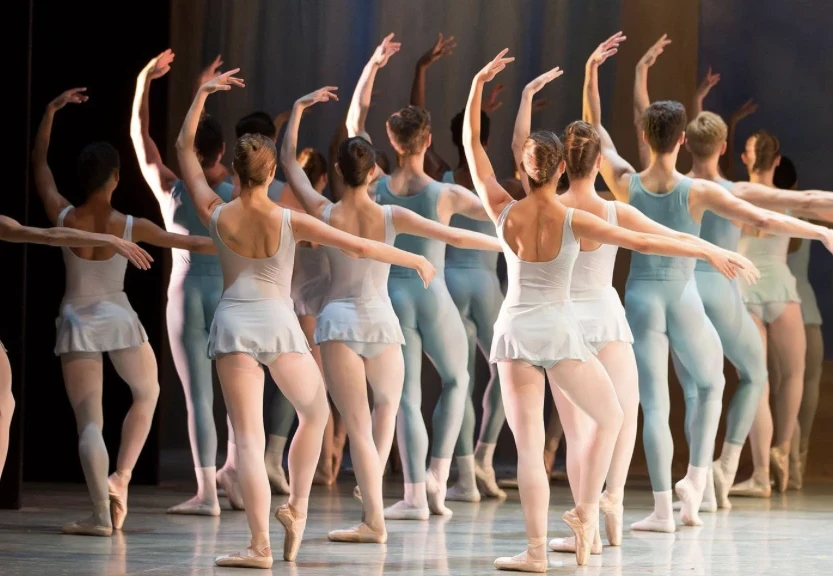
This is clear in Concerto, which is set to the joyous youthful second piano concerto which Shostakovich wrote for his son and matches the airy textures of the score with neat assurance.
The opening movement is set for a principal couple with attendant soloists and corps; movement is bright, dashing, with the principals often identified with the piano while the corps impersonate the orchestral tutti; at the end of the movement, as the cheery opening theme sounds for the last time, the dancers march off in formation, and then the two leading dancers march back on stage for the final chord in a merry, inconsequential fashion.
The lighting dims for the second movement, a sun blooms on the mottled pearl grey of the backdrop and as the piano starts its long, elegiac theme, the ballerina and her partner walk on from opposite sides.
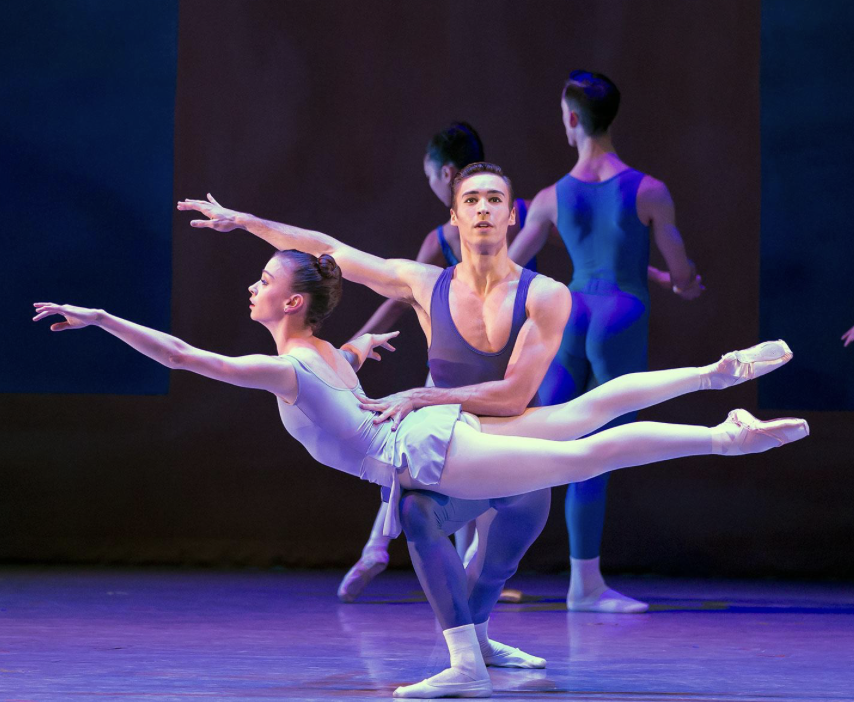
The pas de deux – for this adagio is an extended and radiant duet – starts with the ballerina bending and unfurling her arms in slow port de bras (the pas de deus has its inspiration in the sight of Lynn Seymour warming up in class, and it evokes her presence in marvelous fashion).
The duet is lyrical flowing effortlessly and beautifully, with occasional reflections of its movement in three couples of dancers who appear at the back of the stage, echoing and underlining certain movements of the principle couple (rather as MacMillan did in Diversions).
At its close, the sun fades, the lights come up and we are whisked into the jollity of the last movement.
One leading girl opens this rondo with a sprightly solo, and gradually the other principals, the soloists and the corps are also involved; the dancing is laid out in blocks of movement for wheeling and turning squads of dancers, and at the close the whole cast are involved in a joyous finale,
Here is a part of the ballet danced by principles at the ABT Studio Company.
Kenneth Macmillan staged this happy, lightweight work for his Berlin dancers when he took up his post as director of the Deutshe Opera Ballet: its form and style are dictated by the need he felt to train these dancers in clean, academic choreography, and give his troupe a cohesive and classical style.
Concerto entered the Australian Ballet repertory in 1973.
I hope this has helped when it comes to how to appreciate concerto ballet.



I liked how you explained Concerto through both its musical structure and its stage imagery, which makes the ballet feel much more approachable to someone new to it. The contrast between the bright outer movements and the lyrical central pas de deux really shows why musicality matters so much in understanding this work.
I also found the historical context useful, especially how MacMillan shaped the ballet to strengthen classical technique and ensemble unity. It is interesting how a piece created as training for dancers still comes across as so joyful and elegant to audiences today.
I really loved how you broke down the three movements of Concerto, especially the way you described the contrast between the bright opening and that slow, lyrical pas de deux inspired by Lynn Seymour warming up. It makes so much sense why MacMillan focused so heavily on musicality, since the dancers literally mirror the piano and orchestral textures throughout the piece.
I have always found it fascinating how a ballet originally meant as a training tool ended up feeling so effortlessly joyful on stage. Do you think watching a rehearsal video first helps newcomers catch those subtle musical cues, or is it better to just experience the live performance with fresh eyes?
Although I love watching dance on YouTube there is something even more magical about watching it live, so when you can rather do a live performance.