

Let’s look at some Las Hermanas Ballet History.
Most people haven’t heard of this ballet, but again a lot have so let’s explore it.
Las Hermanas Ballet History
Las Hermanas is a one act ballet that was choreographed by Kenneth Mac Millan and first performed by Stuttgart Ballet on the 13th of July 1963.
The music was by Frank Martin (Concerto for harpsichord and small orchestra)
The decor was don by Nicholas Georgiadis and it is based on Lorca’s play, The House of Bernarda Alba.
Cast:
Marcia Haydee – The Eldest Sister
Ray Barra – the Man
The first performance by the Western Theatre Ballet was at the New Theatre in Cardiff on the 22nd of June 1966.
The first performance by Saddler’s Wells Royal Ballet happened on the 2nd of June 1971 and the Australian Ballet followed at the Sydney Opera House on the 10th of May 1979.
Synopsis:
The curtain is raised in silence to reveal a claustrophobic white and grey interior of a house. The mother limps down the staircase on her walking stick thumping out each step.
Her five daughters sit in rocking chairs, aimless and despondent. They move towards the mother and sit in a line springing from the old woman’s belly.
Gradually the characters of three are revealed. The eldest is an agonized spinster, the middle sister (hunch-backed in Lorca’s play) is envious and embittered, the youngest, still a girl, first comes to our attention when she tries on the bridal veil from a wedding dress draped over a duty in the corner of the room.
The eldest sister, for whom it is intended, puts it on next and the three other sisters dance with it, all the while we are made conscious through the taut and almost desperate dancing of the eldest sister that she is dealing unhappily into spinsterhood.
Now the mother brings on the prospective husband for the eldest as marriage must go by seniority, and we meet a man who reveals under the stiff best suit, a brutal sensuality.
The eldest sister goes out with him, leaving the others rocking and fanning themselves in their chairs as the light fades.
The second scene takes place by night. the man returns freed of his constricting coat to an assignation with the eldest sister.
He tosses gravel to her window. She comes down and they commence a pas de deus which is to reveal much of their characters.
The man is coarsely sensual and the sister at firs if frigid, by also eager for love though she has to conquer years of repression.
Her clenched fists and tense arms indicate how great are her fears. Just as it seems that she is warming to her lover, she realizes that the middle sister has been watching them from a balcony.
Swiftly the kisses the man, shakes his hand formally and goes indoors.
Almost at once the youngest sister rushes out to meet the man and they embark on a frankly sensual duct culminating in a sexual embrace.
The middle sister again has been watching and she at once arouses the household, showing the eldest sister just what her future husband is like.
The elder sister eddies over the stage in agony of mind while the mother raises her stick and tries to strike the man, but the youngest girl snatches the stick from her. The mother then flings the girl to the ground and drives the man from the house, while the eldest daughter expresses her suffering in a solo.
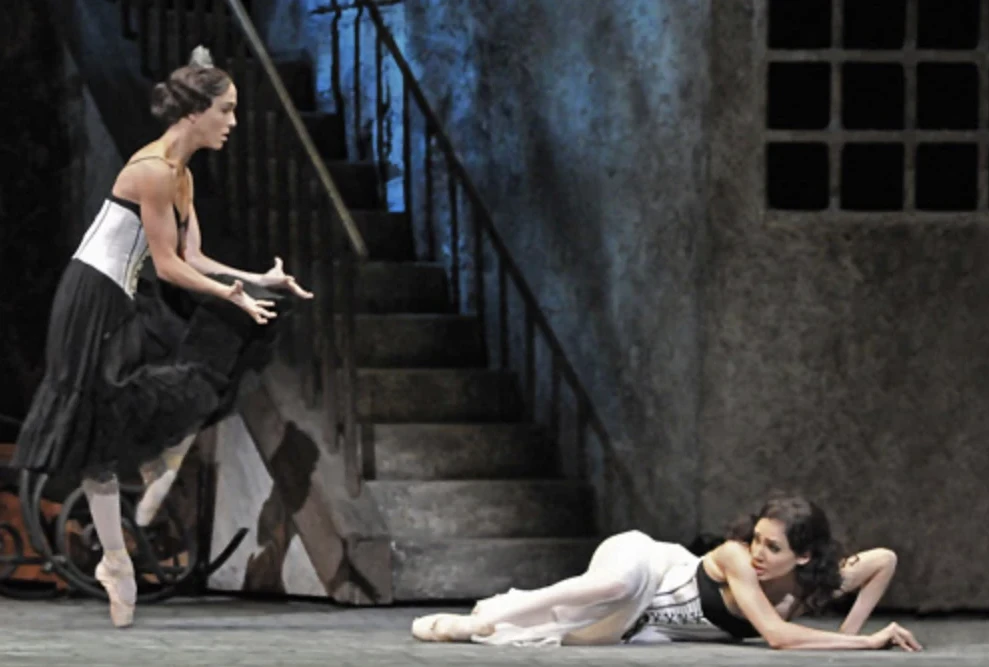
The youngest girl rushes upstairs. The mother gathers her family of women around her and the eldest sister takes one terrifying look out of the window at her lost freedom and happiness.
The mother locks the door with a ferocious finality and limbs the stairs in search of her youngest child. The pulls back the curtains a the stair head and reveals the swinging body of the youngest girl who has committed suicide.
The curtain falls.
About the Choreography…..
As with each of his dramatic ballets, MaMillan is concerned with the interaction of personalities, and the resolution of tensions that bring about a final tragedy.
His habit is to take a dramatic theme, and sometimes by changing and compressing it extensively, to extract what he feels is its emotional essence.
Briefly, In Las Hermanas he presents a claustrophobic house of women where passions, desires and longing are firmly controlled by clearly defined social and sexual conventions. There ar feline jealousies among the girls, and a terrible sense of frustration in the personalities of the eldest sister and the embittered middle sister.
Dominating and controlling is the watchful presence of the mother, a wardress/matriarch presented in, menacing dane images.
Nah of the principals is sharply characterized, the eldest sister cuts tense, frustrated arcs of movement with her arms, and when the man comes to court we witness the turning inward of her emotions by one last despairing runt towards the window, and then isolation and total despair freezes her body.
The man is depicted in an equally powerful manner with an ape like stance, the pungent sexuality are brilliantly shown.
MacMillan always contrives imagery that is entirely opposite and revealing. Nothing could be more succinct than the chain of sisters, each sitting on the other’s lap, springing from the old mothers body, nothing could better suggest the sense of frustrated waiting than the row of girls rocking in their chairs as the ballet begins.
Hermanas is tight in structure and MacMillan compresses the very details action with entire success into the brief space of the Martin Harpsichord Concerto. The result is an excellently shaped work whose tensions never slacken.



Hello Michel,
I really enjoyed reading this piece. Ballet history can sometimes feel a little distant or academic, but the way you explained the story behind Las Hermanas made it feel much more alive and emotional. Knowing that the ballet was created in 1963 by choreographer Kenneth MacMillan and inspired by Federico García Lorca’s play The House of Bernarda Alba adds so much depth to the story and the characters on stage.
What struck me most is how intense the themes are for a ballet. The idea of five sisters living under strict control and competing for affection creates such a dramatic and emotional atmosphere, which feels different from the fairy-tale style many people associate with ballet. It really shows how dance can tell complex human stories without needing any words.
I’m curious, what originally drew you to writing about this particular ballet? Do you think Las Hermanas is one of those works that modern audiences connect with more now than when it first premiered?
Angela M 🙂
Las Hermanas is not a ballet that is performed a lot, but I like to explore all the different ballets from my favorite choreographers on this website, which is why I decided to explore Las Hermanas.
Since Ballet is brand new to me, I could not resist visiting your website to learn from you. I am always going out of my way to learn something new, your article has given me new knowledge on Las Hermanas Ballet.
I am impressed with the details in your article, until reading this I was not aware there was a story in Ballets. I always thought it was just about dancing instead.
The video included is a very good additon to your information, I enjoyed my time on your website and I plan to come back again soon.
Jeff
This is a compelling and well-researched overview that effectively captures the dramatic intensity and emotional depth of Las Hermanas. I appreciate how you’ve connected the choreography to its literary roots while clearly explaining the characters and underlying tensions. Your description of MacMillan’s expressive movement style adds valuable insight into the ballet’s psychological complexity. Overall, this provides readers with both historical context and a deeper understanding of the work’s artistic significance.